AOT 编译原理与实践
你是否想过,为什么有些应用启动速度飞快,而有些却需要漫长的等待?
在现代应用开发中,性能优化是一个永恒的话题。今天,让我们一起来探索 Feat 框架中的 AOT(Ahead-of-Time)编译技术,看看它是如何帮助我们构建高性能应用的。
Feat框架通过AOT(Ahead-of-Time)编译技术实现零反射的运行时环境,在编译期完成所有代码生成和优化工作。这意味着什么呢?简单来说,就是把原本在应用运行时才需要做的工作提前到编译阶段完成,从而大大提升了应用的启动速度和运行效率。
AOT编译的核心是FeatAnnotationProcessor,基于Java APT技术在编译期扫描和处理注解:
实际的注解处理器支持以下注解:
@Overridepublic Set<String> getSupportedAnnotationTypes() { Set<String> types = new HashSet<>(); types.add(Bean.class.getCanonicalName()); // Bean管理 types.add(Autowired.class.getCanonicalName()); // 依赖注入 types.add(Controller.class.getCanonicalName()); // Web控制器 types.add(Mapper.class.getCanonicalName()); // 数据访问层 types.add(McpEndpoint.class.getCanonicalName()); // MCP协议端点 return types;}是不是感觉很神奇?在传统的开发模式中,框架需要在运行时通过反射来分析类结构、处理注解,这不仅消耗时间,还占用内存。而 Feat 的 AOT 技术将这些工作提前到编译期完成,让我们的应用在启动时就能直接运行优化后的代码。
代码生成体系
Section titled “代码生成体系”Feat采用模板方法模式设计了序列化器体系:
优化策略包括:
- 死代码消除:分析依赖关系,只生成实际使用的代码
- 内联优化:将简单的方法调用直接内联到生成代码中
- 类型特化:针对具体类型生成优化的序列化代码
在实际开发中,这些优化策略帮助我们构建出更加高效的代码。比如,当你写一个简单的控制器时:
@Controller("demo2")public class Demo2Controller {
    @RequestMapping("/param1")    public String test2(@Param("param") String param) {        return "hello " + param;    }}
AOT 编译器会将其转换为优化后的代码,完全避免了运行时反射的开销。
代码转换示例
Section titled “代码转换示例”通过真实示例展示AOT编译的代码转换过程:
@Controller("demo2")public class Demo2Controller {
    @RequestMapping("/param1")    public String test2(@Param("param") String param) {        return "hello " + param;    }
@RequestMapping("/param3") public String test4(TestParam param) { return "hello " + param.getParam1() + " " + param.getParam2(); }}/** * Copyright (c) 2022-2025 smartboot.tech All Rights Reserved. * @Author: 三刀 zhengjunweimail@163.com */public class Demo2ControllerCloudService extends AbstractCloudService { private Demo2Controller bean;
public void loadBean(ApplicationContext applicationContext) throws Throwable { bean = new Demo2Controller(); // 直接实例化,无反射 }
public void router(ApplicationContext applicationContext, Router router) { // 生成路由映射代码 router.route("/demo2/param1", ctx -> { JSONObject jsonObject = getParams(ctx.Request); String param0 = jsonObject.getObject("param", String.class); String rst = bean.test2(param0); byte[] bytes = rst.getBytes("UTF-8"); ctx.Response.setContentLength(bytes.length); ctx.Response.write(bytes); });
router.route("/demo2/param3", ctx -> { JSONObject jsonObject = getParams(ctx.Request); TestParam param0 = jsonObject.to(TestParam.class); String rst = bean.test4(param0); byte[] bytes = rst.getBytes("UTF-8"); ctx.Response.setContentLength(bytes.length); ctx.Response.write(bytes); }); }}关键优化点:
- 零反射Bean实例化:直接生成
new Demo2Controller()调用 - 零反射依赖注入:直接生成Bean获取和设置代码
- 预编译路由:编译期生成完整的路由处理逻辑
- 类型安全:编译期确定参数类型,避免运行时类型转换
- 性能优化:生成专用的序列化和反序列化代码
通过上面的示例,我们可以看到 AOT 编译的强大之处。原本需要在运行时通过反射创建对象、解析注解的操作,现在都被直接编译成了高效的 Java 代码。
SPI服务发现
Section titled “SPI服务发现”生成的服务类通过Java SPI机制进行加载:
| 特性 | 传统框架 | AOT模式 |
|---|---|---|
| 编译期优化 | 运行时反射解析 | 编译期静态生成代码 |
| 启动性能 | 需要类扫描和注解解析 | 直接加载预生成代码 |
| 内存效率 | 运行时元数据缓存 | 编译期优化,减少运行时开销 |
| GraalVM支持 | 需要复杂配置 | 原生兼容 |
AOT虚拟机
Section titled “AOT虚拟机”AOT VM模式专为开发阶段设计,通过运行时反射模拟AOT编译行为,提供与AOT模式一致的API体验。
| 特性 | AOT模式 | AOT VM模式 |
|---|---|---|
| 编译期优化 | ✅ 静态生成 | ❌ 运行时处理 |
| 启动性能 | 🚀 毫秒级 | ⚡ 快速 |
| 开发体验 | 🔧 需重编译 | 🔄 热重载 |
| 适用场景 | 🏭 生产环境 | 🧪 开发测试 |
两种模式都遵循相同的Bean生命周期管理规范:
启用AOT VM模式
Section titled “启用AOT VM模式”要启用AOT VM模式,需要对Maven项目进行以下配置:
-
添加profiles配置:
<profiles><profile><id>feat-aot-vm</id><properties><!-- 必须为true,以便 AOT VM 运行时识别方法参数名 --><maven.compiler.parameters>true</maven.compiler.parameters></properties><dependencies><dependency><groupId>tech.smartboot.feat</groupId><artifactId>feat-cloud-starter</artifactId><version>${feat.version}</version><exclusions><!-- 禁用 AOT 组件 --><exclusion><groupId>tech.smartboot.feat</groupId><artifactId>feat-cloud-aot</artifactId></exclusion></exclusions></dependency><!-- 启用 AOT VM 组件 --><dependency><groupId>tech.smartboot.feat</groupId><artifactId>feat-cloud-aot-vm</artifactId><version>${feat.version}</version></dependency></dependencies></profile></profiles> -
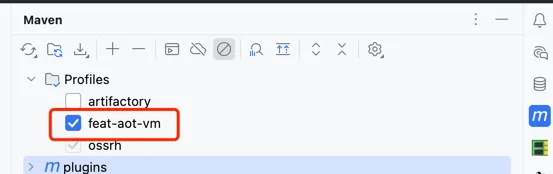
在IDEA中勾选相应的profile以激活AOT VM模式