
Product Introduction

About smart-mqtt
Section titled "About smart-mqtt"smart-mqtt is designed for enterprise-level IoT scenarios with tens of thousands of device connections. It is also the first commercial product launched by the smartboot open-source organization, marking a significant strategic transformation from community-driven to sustainable development in the IoT field.
Why Commercialization?
Section titled "Why Commercialization?"In the open-source world, we have witnessed many excellent projects gradually fade away due to lack of sustainable investment. The development of an enterprise-level MQTT Broker is no easy task - from protocol compatibility to massive connection support, from plugin ecosystem to operations toolchain, every aspect requires long-term investment from a professional team.
The essence of commercialization is to build a healthy value cycle: users get stable and reliable products and services, and the team gets resource guarantees for continuous iteration. This is not a departure from the open-source spirit, but a necessary choice to make open-source projects go further.
Our Expectations
- Open Source Code: All product features are open source, users can choose freely.
- Quality Assurance: Gradually stricter testing processes and SLA systems
- Long-termism: Reject short-term profit-taking, committed to building products that stand the test of time
We believe: Good products deserve to be priced, and continuous value deserves to be invested in.
Core Advantages
Section titled "Core Advantages"| Advantage | Business Value |
|---|---|
| 🚀 Ultra High Performance | Continuously optimized for 100K+ device access scenarios, featuring high throughput and low latency, the larger the connection volume, the more obvious the cost advantage |
| 🔧 Open Architecture | Plugin-based design for on-demand expansion, southbound adaptation to multi-protocol devices, northbound bridging to enterprise systems, rejecting feature redundancy |
| ☕ Java Ecosystem | Zero-barrier integration with existing tech stack, team gets up to speed quickly, mature operations toolchain, no burden for long-term maintenance |
| 🔄 Standard Protocol | Fully compliant with MQTT 3.1.1/5.0, no vendor lock-in, business autonomy, smooth migration at any time |
| 🇨🇳 Self-controllable | Full-stack self-developed core components, transparent and secure code, compliant with government and enterprise information innovation requirements |
Main Features
Section titled "Main Features"smart-mqtt, through its built-in enterprise-plugin, serves as the foundational core component of the product, providing a fully-featured Web management console and powerful plugin lifecycle management capabilities.
After the service starts normally, you can access the platform login page through a browser at http://localhost:18083/ (adjust IP according to actual situation).
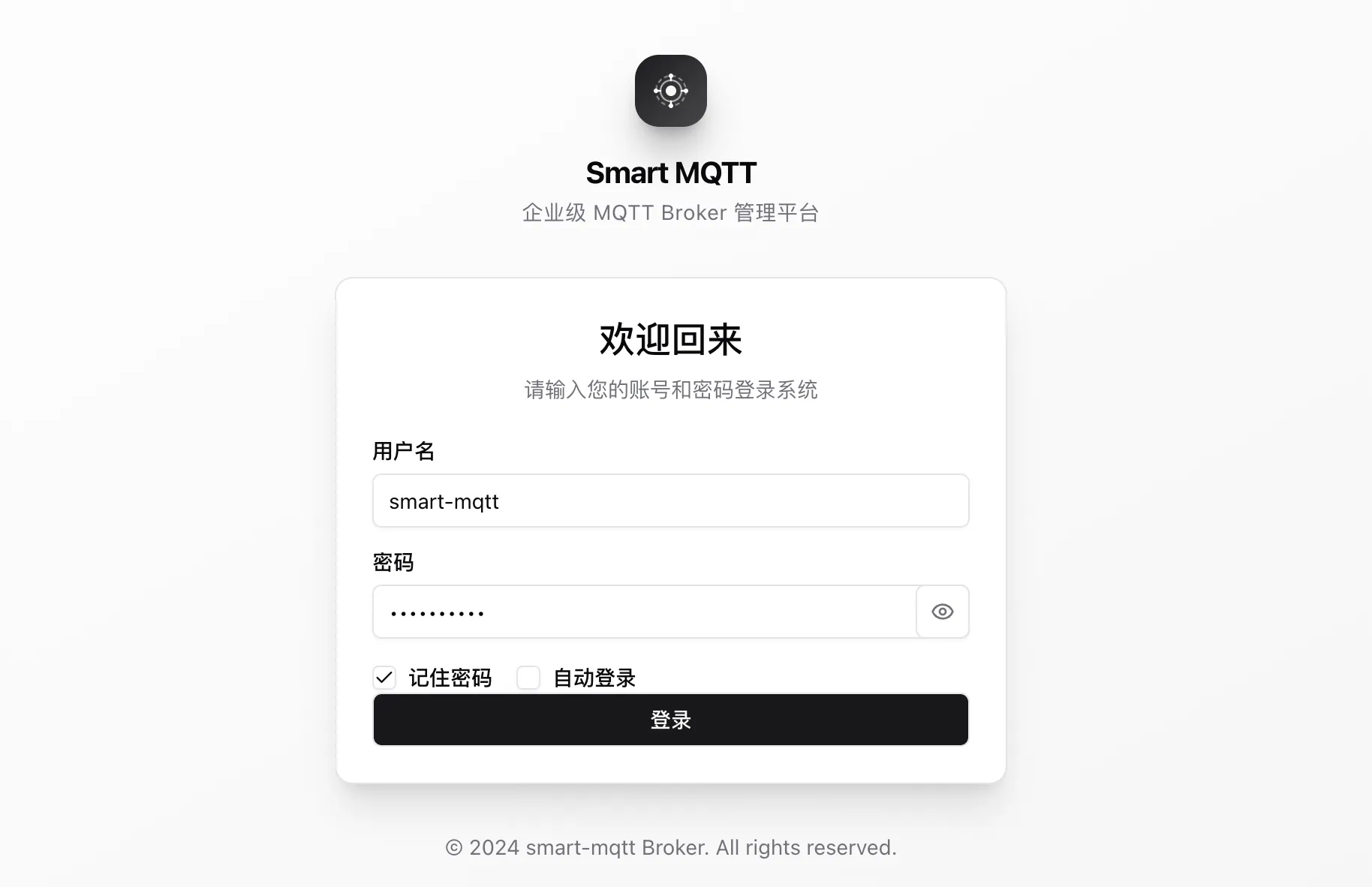
The management platform provides RESTful APIs based on HTTP services, with the frontend built using the Shadcn UI framework. Main functional modules include:
| Functional Module | Description |
|---|---|
| User Authentication | Session-based user login, supports username + password authentication |
| License Management | Authorization verification, License import, status display |
| Broker Management | Cluster node list query |
| Connection Management | MQTT client connection query, forced disconnection |
| Topic Management | Subscription relationship query, Topic statistics query |
| Plugin Management | Plugin list, start/stop control, configuration management, plugin marketplace, local upload installation |
| System Settings | User management, system parameter configuration |
Dashboard
Section titled "Dashboard"The dashboard is the visual data display center of the management platform, providing real-time monitoring capabilities for Broker running status:
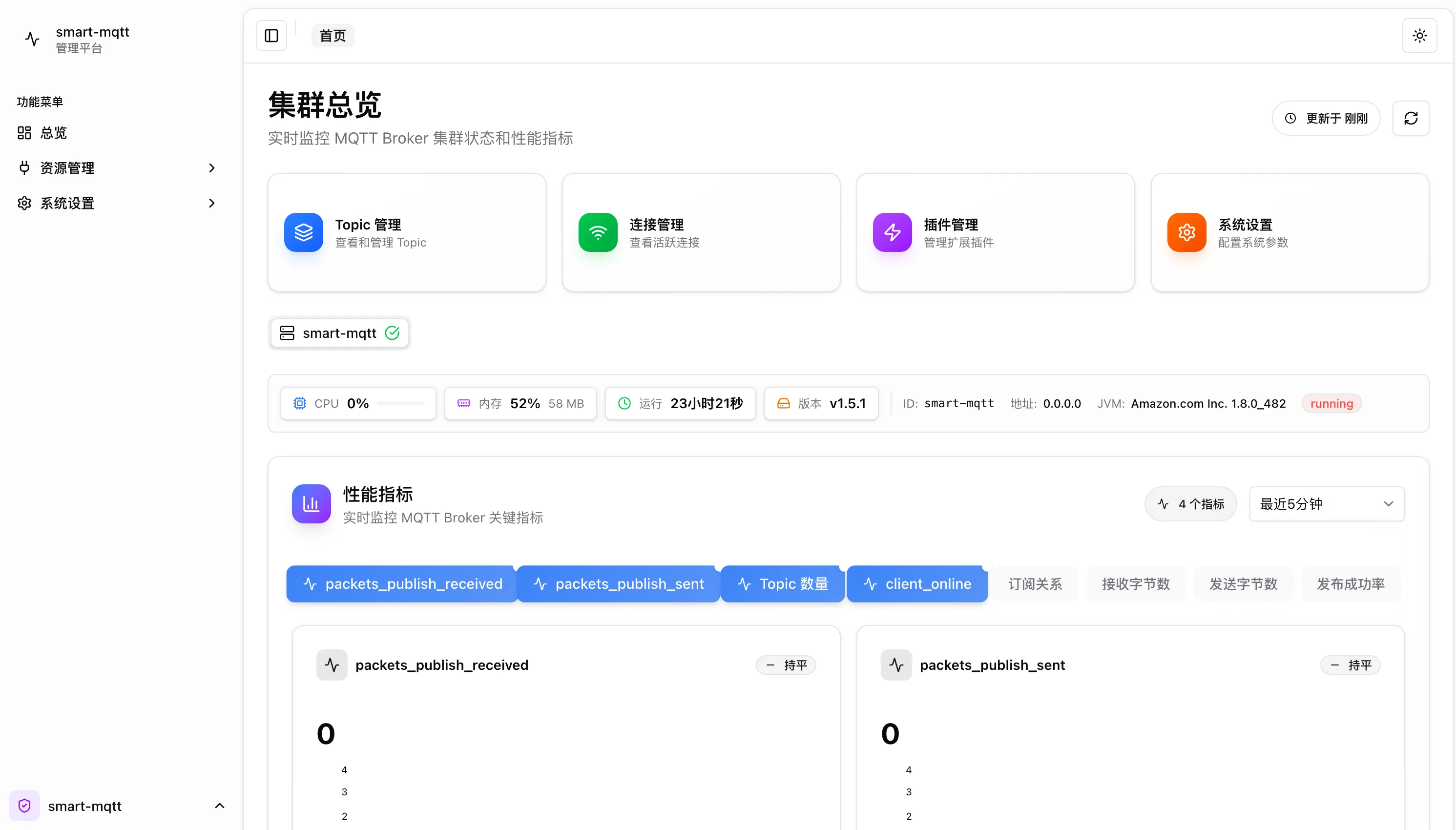
- Connection Metrics: Real-time display of current active connections, historical connection peaks, connection rates, and other key indicators
- Message Metrics: Monitor message send/receive rates, throughput, message backlog, etc.
- System Resources: Display server CPU, memory, disk, and other basic resource usage
- Trend Charts: Support displaying metric change trends by time dimension for analyzing business patterns
Connection Management
Section titled "Connection Management"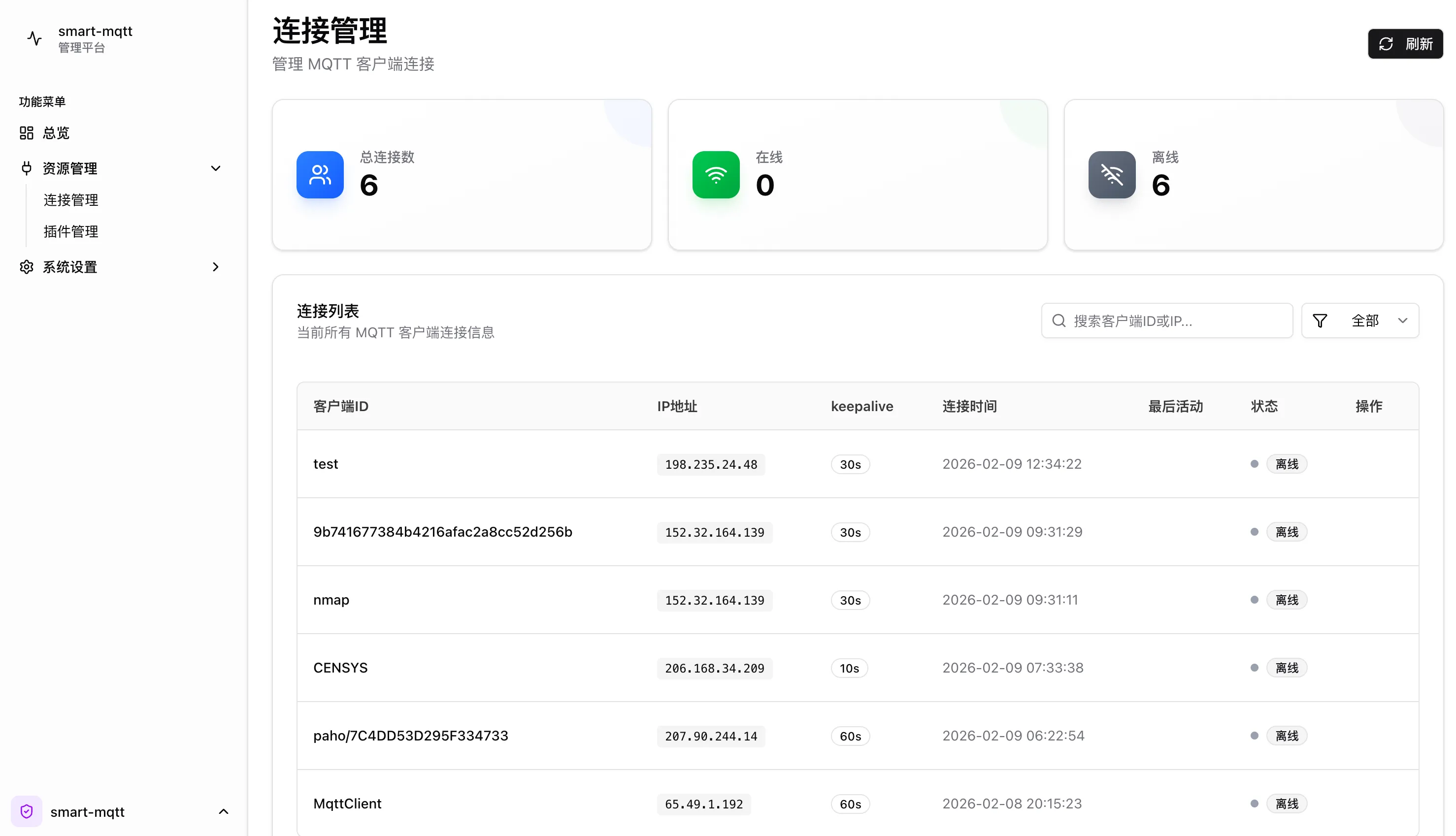
- Connection List Query: Supports paginated queries, fuzzy search by ClientID
- Connection Information Display: ClientID, username, IP address, connection time, last activity time, status
- Forced Disconnection: Can actively disconnect specified client connections
Plugin Management
Section titled "Plugin Management"IoT business from POC to mass production, from single device access to multi-protocol fusion, requirements are always in dynamic change. smart-mqtt’s plugin management system allows enterprises to build and evolve their own MQTT platform like building blocks, on-demand.
Solving Three Core Pain Points
Section titled "Solving Three Core Pain Points"| Pain Point | Solution |
|---|---|
| Feature Redundancy or Missing | Enable WebSocket, cluster, data bridging and other capabilities on-demand, use as much as needed |
| Change Means Downtime | Plugin hot-plugging, configuration takes effect in real-time, version seamless upgrade |
| Custom Requirements Hard to Implement | Standardized interface supports private plugin development, enjoying the same management experience as official plugins |
Layered Capabilities, On-demand Expansion
Section titled "Layered Capabilities, On-demand Expansion"- Connection Layer: WebSocket, SSL/TLS, multi-protocol gateway
- Security Layer: Simple authentication, enterprise-level authorization, ACL permission control
- Data Layer: MySQL persistence, Redis bridging, message queue integration
- Architecture Layer: Cluster expansion, session persistence, monitoring and alerting
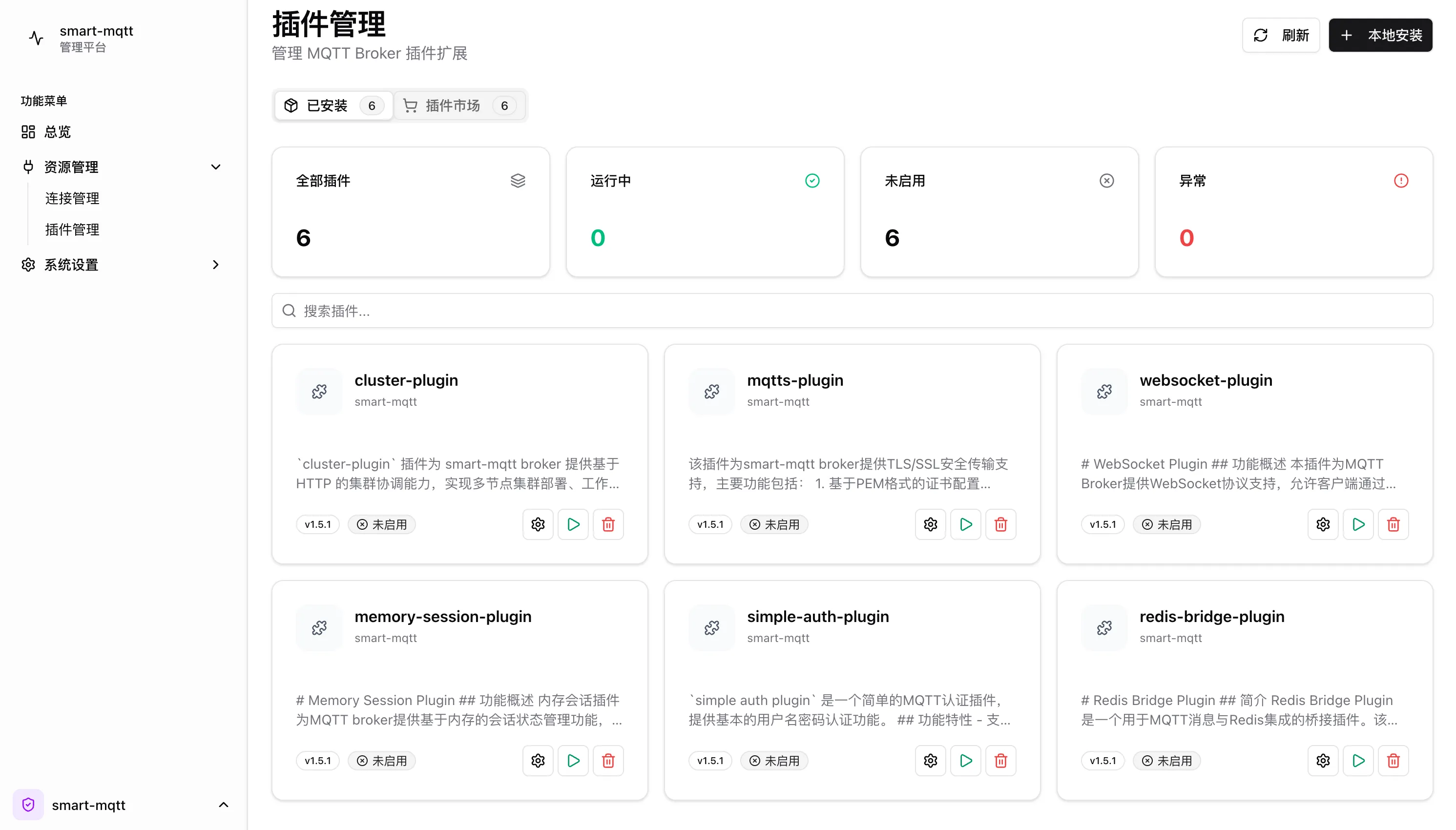
One Sentence Summary: Plugin management transforms smart-mqtt from a standardized Broker into an IoT communication platform that can flexibly evolve with business, making technology truly serve business.
Plugin Discovery and Acquisition
Section titled "Plugin Discovery and Acquisition"Plugins provided officially by smart-mqtt are all built into the product. smart-mqtt also provides two plugin integration methods to meet different scenario needs:
-
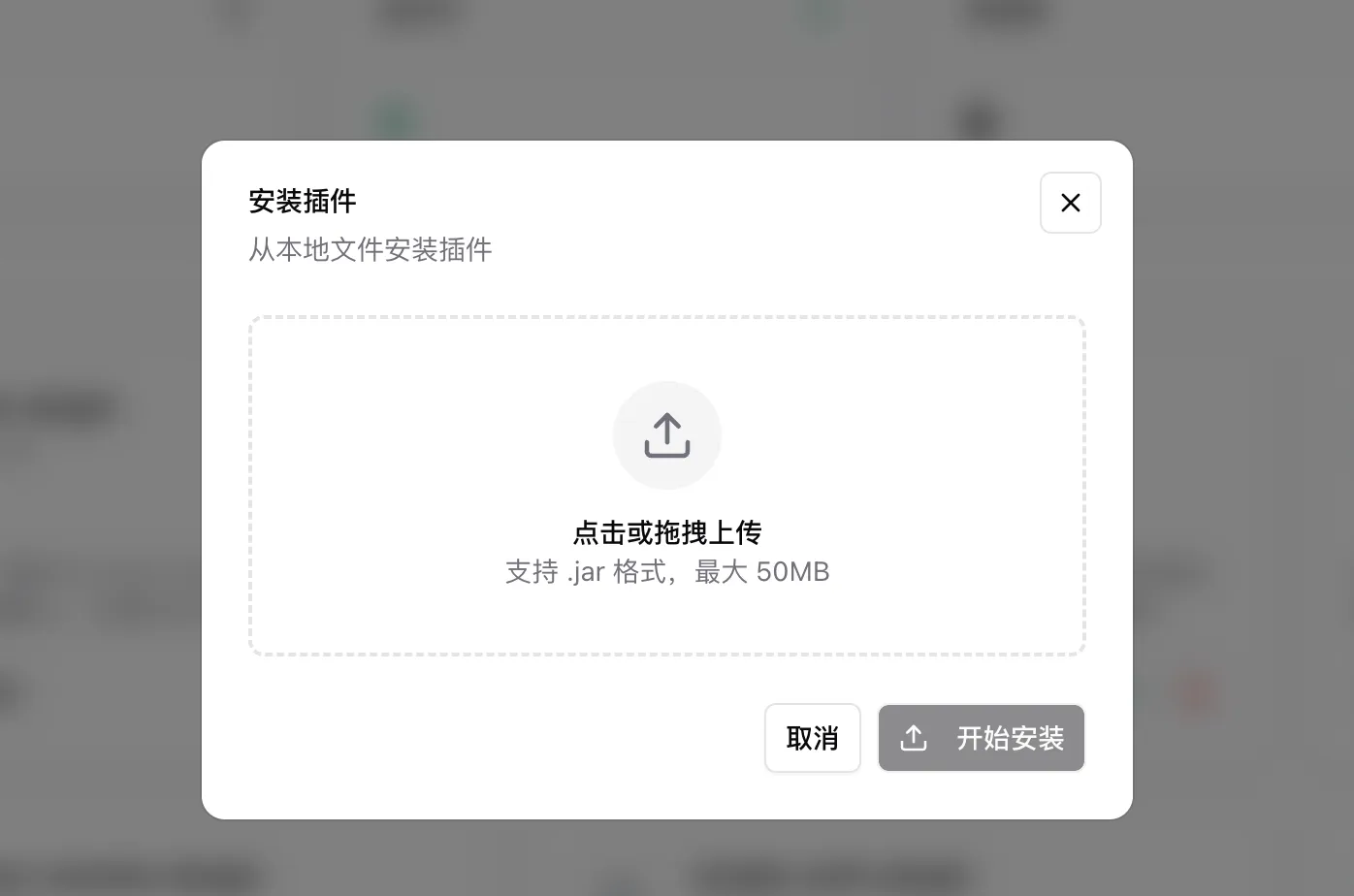
Local Upload Supports uploading custom-developed JAR packages for installation, meeting privatization deployment and secondary development needs
-
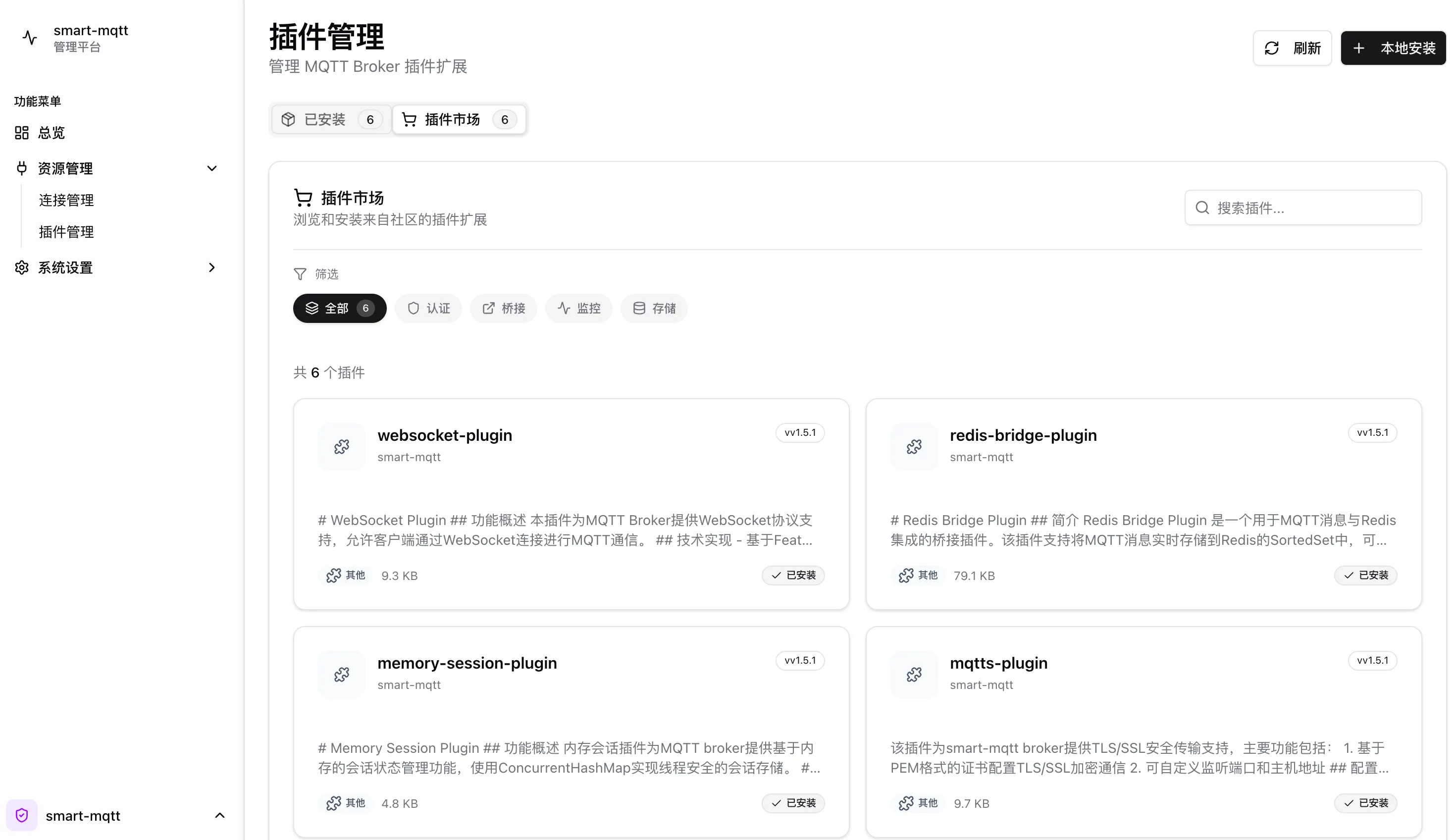
Plugin Marketplace Connect to remote official plugin repository, browse, search and download published plugins
User Management
Section titled "User Management"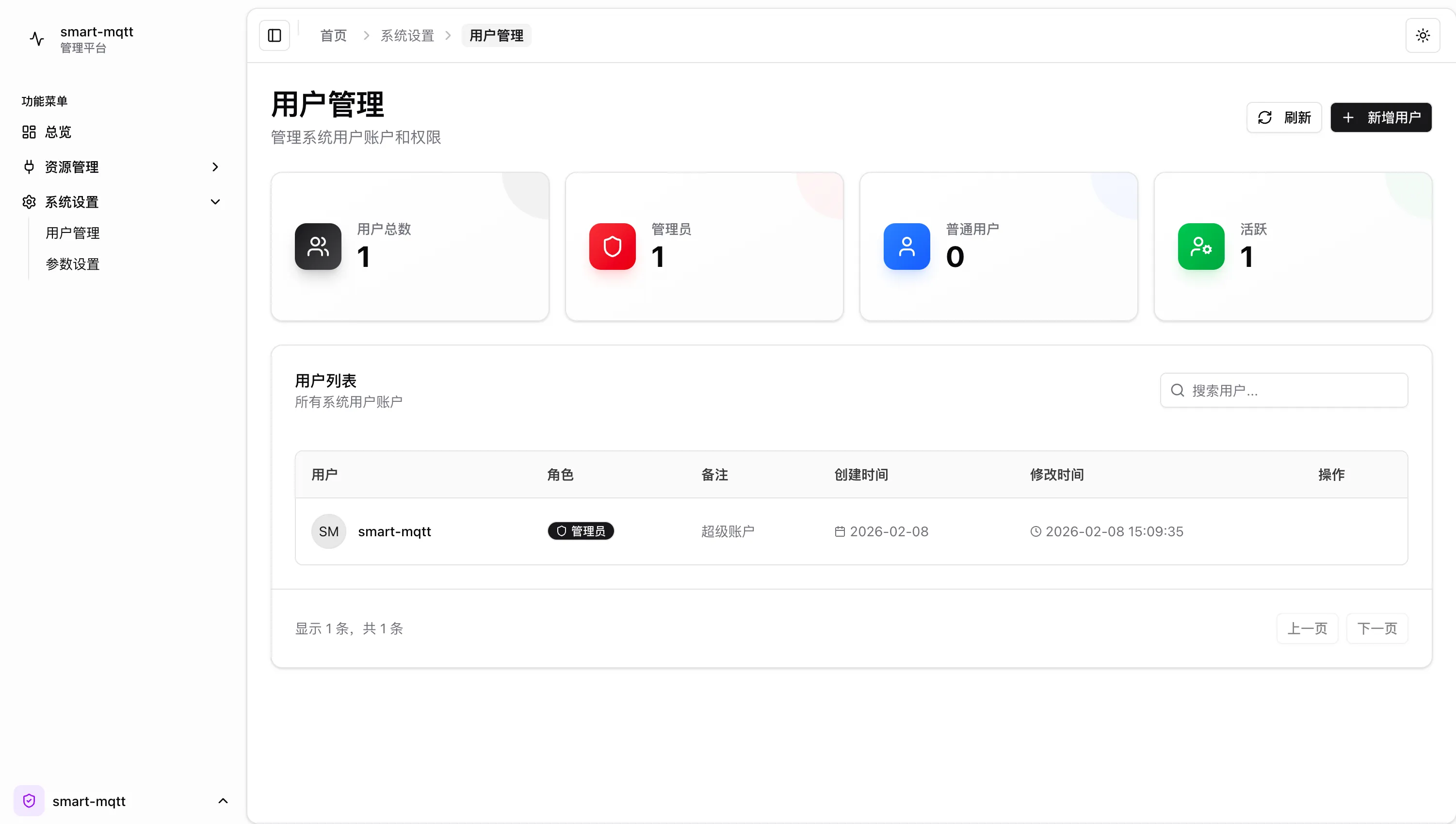
| Function | Description |
|---|---|
| User List | Paginated display of user information (username, role, description, creation time) |
| Add User | Create new user, set username, password, role |
| Update User | Modify user information, supports password reset |
| Delete User | Batch delete user accounts |
| Role Management | Supports two roles: administrator and regular user |
System Parameters
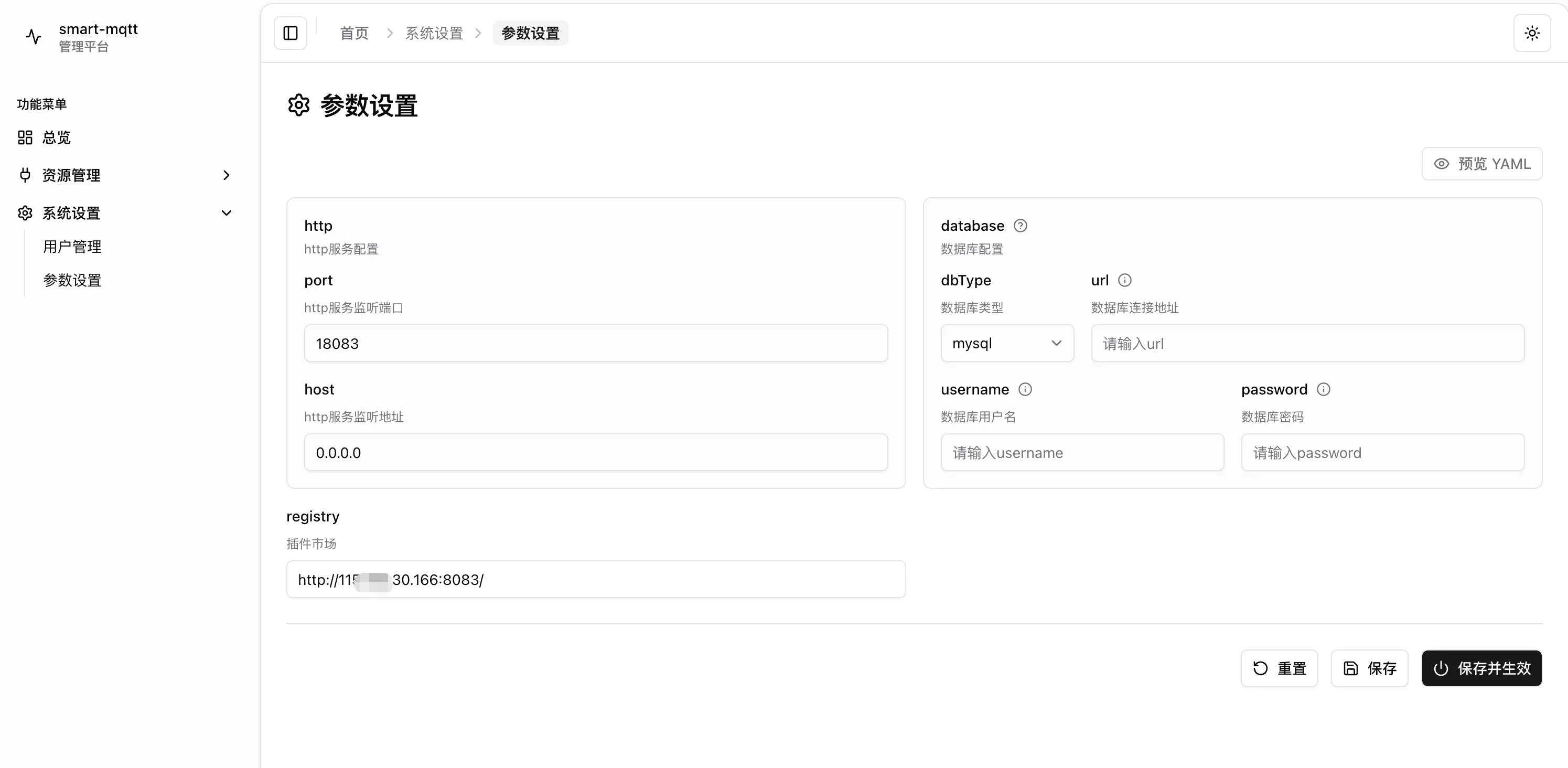
Section titled "System Parameters"System parameters are used to configure the core operating parameters of the smart-mqtt management platform, provided through the enterprise-plugin plugin.
| Parameter | Description | Default Value |
|---|---|---|
| http.port | HTTP service listening port, used to access Web management console and RESTful API | 18083 |
| http.host | HTTP service listening address, 0.0.0.0 means listening on all network interfaces | 0.0.0.0 |
| database.dbType | Database type, supports h2 (file mode), h2_mem (memory mode), mysql | h2 |
| database.url | MySQL database connection address, only takes effect when dbType is mysql | - |
| database.username | MySQL database username, only takes effect when dbType is mysql | - |
| database.password | MySQL database password, only takes effect when dbType is mysql | - |
| registry | Plugin marketplace address, used to browse and download official plugins (currently experience server) |
Connection Flapping Protection
Section titled "Connection Flapping Protection"When MQTT clients frequently connect/disconnect due to network anomalies or program defects, it consumes a large amount of server resources and affects other normal clients. The connection flapping protection function protects the system through the following mechanisms:
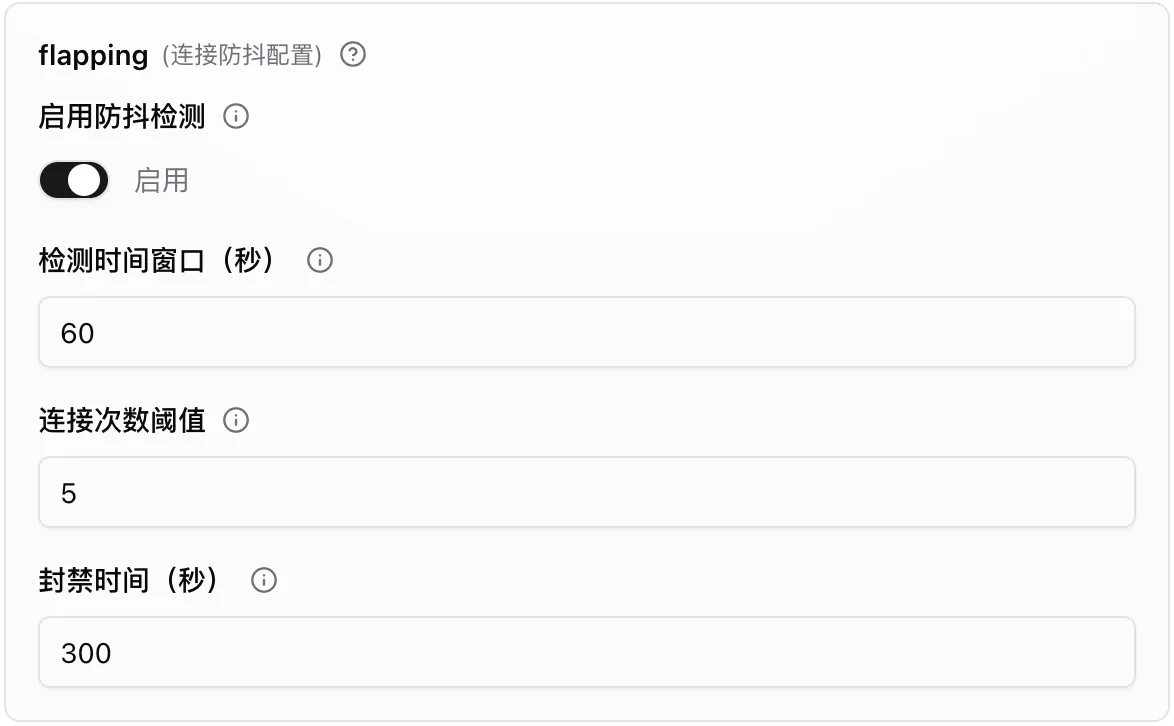
Configuration Entry: System Settings -> Parameter Settings -> Connection Flapping Protection
- Time Window Statistics: Count each client’s connection attempts within
thresholdDurationseconds - Threshold Determination: When connection attempts exceed
thresholdCount, the client is determined to be flapping - Automatic Ban: Ban flapping clients for
banTimeseconds, rejecting all their connection requests during this period - Automatic Unban: Automatically lift the ban after the ban period expires, no manual intervention required
Cost Comparison
Section titled "Cost Comparison"The procurement cost of cloud products grows almost linearly with connection volume, while smart-mqtt inherently has performance overflow advantages, so the larger the connection volume, the higher the cost-effectiveness.
| Specification | SaaS Cloud Product Annual Fee | smart-mqtt Self-built Cost (Annual) |
|---|---|---|
| 1000 connections/1000TPS/1000 subscriptions | 17K | 3K~5K (hardware) + license fee |
| 50000 connections/20000TPS/1000 subscriptions | 370K | 10K~20K (hardware) + license fee |
| 1M connections/200K TPS/1M subscriptions | 3.768M | 150K~300K (hardware estimate) + license fee |
Data source: Alibaba Cloud IoT, Huawei Cloud IoT
Note: smart-mqtt self-built cost is an estimate of server hardware costs (3-year depreciation), including server, bandwidth, operations and other infrastructure costs. Actual costs vary by configuration, region, and operations strategy, for reference only.